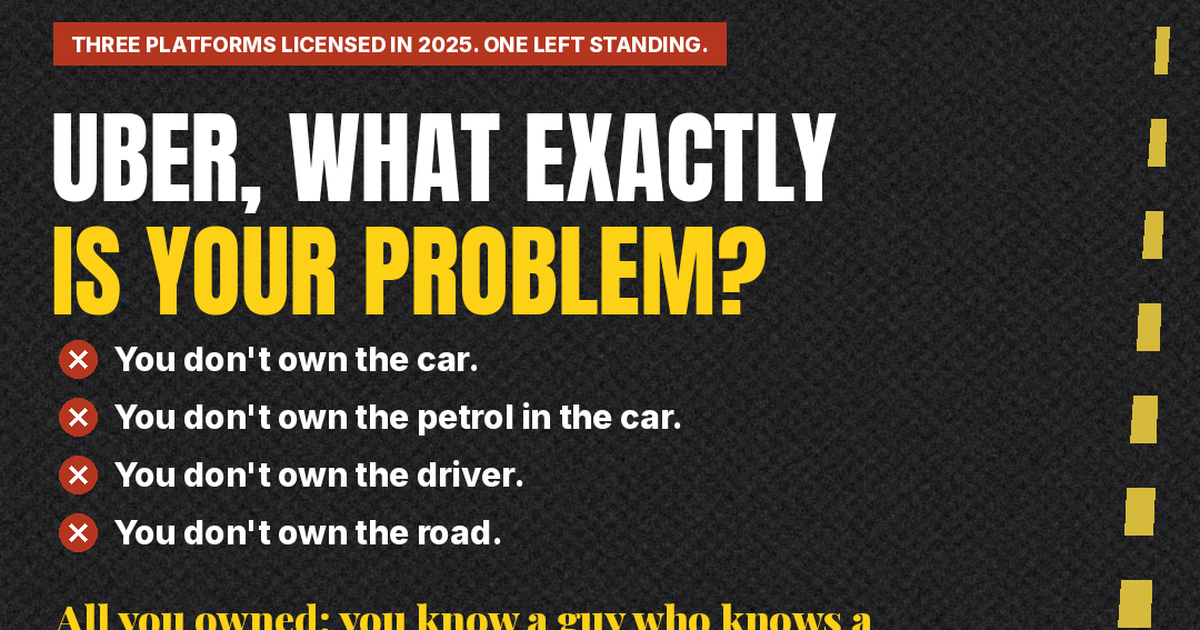
Three Platforms Licensed. One Left Standing.
In January 2025, the Ivorian state licensed three ride-hailing platforms: Uber, Yango and Heetch. The telecoms regulator and the land transport directorate signed off together. It looked like a wedding celebrated in front of the whole village.
Twenty-one months later, take the register.
Uber switched off its app at the end of September 2025, almost six years after arriving in December 2019. Heetch switched off its own on 27 June 2026. Yango is still here. The motoring press credited it with around 25,000 registered vehicles in September.
Three were handed the keys to the house. Only one still sleeps there.
Uber, what exactly is your problem?
You don't own the car. You don't own the petrol in the car. You don't own the driver. You don't own the road.
The only thing you owned was this: you know a guy who knows a guy.
And with that, you still failed in Nigeria. In Nigeria. The one country where everybody knows a guy who knows a guy.
On 2 September 2026, after twelve years, Uber left Nigeria, and Uganda after ten, without giving a specific reason beyond "shifting business priorities". A platform that owns nothing but the introduction, and then loses the battle of introductions, is a griot who forgets the families' names. He can still sing. Nobody pays him any more.
What you will be told
You will be told Uber fell in Abidjan over a payment detail: it paid drivers weekly, in a city where the tank is filled in the morning. The argument circulates, it is attractive, and I wrote it myself in September.
It is incomplete.
In January 2025, eight months before leaving, Uber had added instant mobile-money payouts for its Ivorian drivers. And it had accepted cash since launch. A problem fixed eight months before the end is not, on its own, the cause of the end.
What weighed more
The money across the street. The Africa Report says Yango was spending millions of dollars a month subsidising rides. When the neighbour sells bread cheaper than flour, the quality of your oven decides nothing.
Price. Uber positioned itself higher, for a wealthier clientele. In Abidjan most of the traffic is won franc by franc, and the passenger who haggles over a shared-taxi fare does not pay double for an app.
Size. For Uber, Abidjan was a small market. The same day it left Nigeria, the group launched autonomous rides in London, still overseen by a licensed driver sitting on board. Capital goes where it hopes one day to do without the driver. Abidjan is not on that map yet.
The other side: a market with one head
This is good news for neither passenger nor driver.
When two of the three licensed platforms have left, the one that stays sets prices, commissions and rules. A single cockerel in the yard crows whenever it likes.
On 13 August 2026, the transport directorate itself admitted the sector was in "grand désordre" — great disorder — with "un manque de statistique fiable", no reliable statistics to regulate it. It announced a pilot licence, a price comparator and a fare cap. I have not yet seen any of the three in service.
A regulator without numbers is refereeing a match without knowing the score.
What this changes if you are entering with a platform model
Rides, deliveries, subscriptions: ask three questions before the first line of code.
- Who waits, and for how long? Driver, courier, merchant: in your model, who fronts the money, and when do they get it back? In Abidjan, the tank is filled in the morning.
- Who is subsidising across the street, and until when? If your competitor is burning cash to buy the market, your plan must say how many months you last without following.
- Who is counting? If the regulator has no statistics, your dashboard will be the only truth in the room. Keep it like evidence.
Arriving with the best model in the world is not enough. You need the one still standing the day the other side cuts its prices.
Come with your model; leave knowing who in your chain is waiting for their money.
What I could not verify
- Yango's actual payout rhythm to drivers: sources contradict each other, I do not settle it.
- Each platform's exact commission: only driver blogs quote it.
- The status of inDrive, which operates in Abidjan: I found no published licence.
- The number of active drivers today: the regulator itself says it has no reliable statistics.
Sources
- Ecofin Agency, 29 September 2025; LaunchBase Africa, 29 September 2025 — Uber leaves Côte d'Ivoire.
- Connection Ivoirienne, 6 December 2019 — Uber launches in Abidjan.
- Africa Signal, September 2026 — January 2025 licences; Uber's instant payouts, January 2025.
- Afriveille, 26 June 2026 — Heetch closes on 27 June 2026.
- AutoMag, 11 September 2026 — Yango fleet (press).
- The Africa Report — Yango subsidies.
- Digital Mag, 2025 — Uber / Yango price comparison.
- BBC, The Africa Report, Al Jazeera, September 2026 — exit from Nigeria and Uganda; The Africana Voice — "shifting business priorities".
- Uber Newsroom, 2 September 2026 — autonomous rides with Wayve in London.
- Government of Côte d'Ivoire, gouv.ci, 13 August 2026 — reforms announced by the DGTTC.
Written from Abidjan.
Planning an entry — or bleeding in one?
Book a 20-minute Terrain Briefing. Bring one specific market question; leave knowing what it costs to get it right versus wrong.
Book a Terrain Briefing