OAPI Grants Your Title. The Protocol Will Not Say Its Name.
Walk into the Office Ivoirien de la Propriété Intellectuelle in Abidjan with a name you want to own.
They take the file. They check it. Then they put it in an envelope and send it to Cameroon, because the OIPI's own description of its job says it receives and examines applications "with a view to transmitting them to the headquarters of OAPI in YAOUNDÉ." The French Treasury says it flatter still: the granting of patents, trademarks and designs happens there, exclusively.
There is no Ivorian trademark. There never was one for you to choose instead.
They did not harmonise. They handed it over.
We all know what harmonisation looks like here. Ministers sign the same paper, everybody carries it home, and then each house cooks it its own way. The text is common. The ground is eight, or seventeen, or fifty-five.
The Bangui Agreement did not do that. Seventeen states took a whole branch of property law, gave it to one building in Yaoundé, and kept nothing back.
The regional route is not one road you weigh against another. It is the road — trademarks, patents, utility models, industrial designs, geographical indications, layout designs of integrated circuits, plant varieties. One application, and the title stands in all seventeen states. You cannot pick five and skip twelve. The Agreement itself serves as national law in each member state. Copyright sits inside the Agreement too, at Annexe VII, but it is collected and administered at home, by the national societies — BURIDA in Abidjan, BSDA in Dakar.
Seventeen countries. One counter. That is not a plan for a single market. It is one, it runs in French, and it has been running for decades while conference after conference asks whether such a thing can be built on this continent.
And it took nine years to switch on
Here is the part that gets cut when OAPI is waved about as a success, and cutting it is how you get laughed at by somebody who actually files.
Bamako, 14 December 2015. The revised Agreement entered into force on 14 November 2020 — five years later — once two thirds of the seventeen had deposited their instruments. It came in with four of its ten annexes: geographical indications, literary and artistic property, unfair competition, plant varieties. Three more landed in January 2022: trademarks, industrial designs, trade names.
Patents and utility models came last. 1 January 2025. Nine years after the signature, and only for applications filed on or after that day.
Two things arrived with them, and if you hold industrial property in this zone, stop here.
Examination. Until 1 January 2025, OAPI granted patents without checking whether the invention was actually new. Examiners are now being trained in Cameroon and Côte d'Ivoire. So every OAPI patent in force today that was filed before 2025 was granted without that check. Yours. And the one your competitor is waving at you.
Opposition. There is now a three-month window from publication for somebody to challenge an application. Before, there was none.
That is what real unification looks like from the inside. Not a ribbon. Nine years of ratifications and annexes coming on one at a time, and the oldest, most valuable rights in the system were the last to get a modern text.
Now the bill, and who pays it
This is the part nobody says out loud, and it is the reason I would not hand this model to anyone without a warning label.
Twelve of OAPI's seventeen members are least developed countries. Only five are not: Cameroon, Congo, Côte d'Ivoire, Equatorial Guinea, Gabon.
Under the WTO rules, a least developed country does not have to grant patents on pharmaceutical products until 1 January 2033. That is not charity. It is a flexibility those countries fought for, and it exists so that a poor country can let generics in while it builds something of its own.
Twelve OAPI members hold that right. Not one of them can use it.
Because the Bangui Agreement applies one patent law to all seventeen, with no line drawn between a developing country and a least developed one. The South Centre, in a research paper on exactly this question, puts it in one sentence: "no Member State would be allowed to adopt a national measure contrary to the Bangui Agreement."
Read that again with the twelve in mind. A country can be poor enough that the World Trade Organization says it need not grant pharmaceutical patents. And it still grants them — every day, automatically — because it gave away the law that would have let it decide.
That is the price of the single title, and it is not paid at the filing counter.
I am not telling you the system is bad. I am telling you it is a bargain, it was struck decades ago by people who knew what they were trading, and anybody who holds it up in a conference room as a model to copy has an obligation to say what it cost. The South Centre's own recommendation is to amend the Agreement so the twelve can use what is theirs. That recommendation is sitting there. Nobody has acted on it.
Now open the Protocol
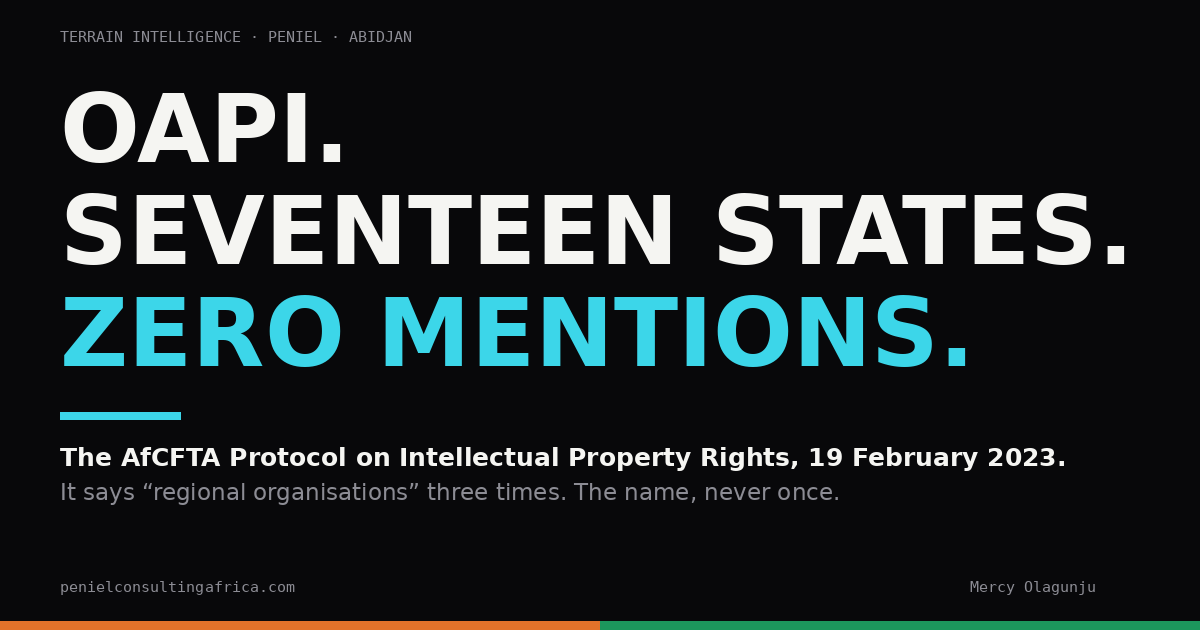
The AfCFTA Protocol on Intellectual Property Rights was adopted by the African Union Assembly on 19 February 2023. It enters into force thirty days after the twenty-second ratification. Search the African Union's own published text for the word OAPI.
It is not there. ARIPO is not there either.
And they are not absent the way something is forgotten. They are referred to three times as a category and never once by name. The preamble recognises "the achievements of national intellectual property systems, the regional economic communities and the regional intellectual property institutions in Africa." Article 33 has the Secretariat working with "regional intellectual property organizations." Article 31 has the new AfCFTA Intellectual Property Office cooperating with "existing and emerging national, regional and international intellectual property offices."
Three chances to write four letters. Nobody took one.
What Article 31 does instead is send the whole relationship — every practical question a rights holder has — to an Annexe. And the AfCFTA Secretariat itself said in July 2026 that "a limited number of legal instruments remain under negotiation — notably an outstanding Annex to the Investment Protocol and a remaining Annex to the Protocol on Intellectual Property Rights."
That is the one. The Annexe that would say how the new Office and the old one talk to each other is the Annexe that is not finished.
And the eight that are finished, adopted by Heads of State in February 2026 — covering marks, patents, industrial designs, utility models, geographical indications, plant varieties, copyright, and traditional knowledge — are reported as not yet published. Adopted. Unreadable.
The answer exists. It is two documents away.
Now the part that took reading the text instead of the commentary about the text.
Article 36 of the Protocol carries the heading "Conflict and inconsistency with other Agreements", and it is one sentence: "Any conflict and inconsistency between the provisions of this Protocol and a regional intellectual property agreement shall be resolved in accordance with Article 19 of the AfCFTA Agreement."
Article 19 has two paragraphs. The first: the AfCFTA Agreement prevails over a conflicting regional agreement, to the extent of the inconsistency. The second: States Parties belonging to arrangements that have reached higher levels of integration than the AfCFTA "shall maintain such higher levels among themselves."
A single mandatory title granted by one office across seventeen states is a higher level of integration than anything in the Protocol. There is no serious argument the other way.
So on the text, the answer to the only question a rights holder actually asks is: OAPI stands. Article 19(2) holds it up.
Sit with the shape of that. The protection is real and it is written down — in a different treaty, reached by a cross-reference, in favour of an organisation the Protocol will not name, while the Annexe that would explain how the two offices work together is the one still unfinished, and the eight that are finished cannot be read.
That is not a legal problem. A lawyer works fine with a cross-reference. It is a silence, and silence is what makes money price a market as dangerous when it is not.
What they will say back in Nairobi
The seventh All Africa IP Summit runs 11 to 13 November 2026 in Nairobi, with the AfCFTA Secretariat, on mainstreaming intellectual property for African trade. The objection to everything above is already in that room, so here it is at full strength, because a point you cannot argue against yourself is not a point.
OAPI works because it is small and alike. Seventeen states, one working language, one legal tradition, one office, and a shared legal inheritance that made a common text writable in the first place. The AfCFTA is fifty-five states, four or five languages, civil law and common law and everything in between, and offices that run from world-class to two people and a cabinet.
And there is a harder version than the practical one. OAPI works because its members are monist: a treaty becomes law without a domestic statute, which is precisely what lets the Bangui Agreement serve as national law. Ask a dualist common-law state to let a continental title bind its courts without an act of its own parliament and you have stopped discussing intellectual property. You are discussing its constitution.
Then add the twelve. If the price of a unitary title is that a poor member cannot use a WTO flexibility it is entitled to, a minister in Abuja or Pretoria is right to go slowly.
All of that is correct, and none of it answers the question. Nobody is asking the Protocol to become OAPI. They are asking it to say the word.
What this changes for you on Monday
If somebody quotes you country by country across francophone West and Central Africa, they are billing you for work the law does not allow. One question settles it: which office receives the application? If the answer is not Yaoundé, through a national liaison structure, the file is not going where titles are granted.
Check the date of your filing, not just the type of your right. The 2015 text reached trademarks, designs and trade names in January 2022, and patents and utility models on 1 January 2025 — and the patent annexes bite only on applications filed on or after that day. Two applications for the same invention, same office, one filed in 2023 and one last month, are not under the same regime.
If you are buying a company for its OAPI patents, ask when they were filed. Anything before 2025 was granted without examination for novelty. That is not a reason to walk away. It is a reason to run your own search instead of trusting the certificate.
Know where you go when you are refused, because it is not a courthouse you can drive to. A refusal by the Director General goes to OAPI's Commission Supérieure de Recours — three members and three alternates drawn by lot from a list of judges supplied by the member states, sitting in ordinary session two or three times a year. OAPI's own page says its decisions "are final and not subject to any administrative appeal." Find out when it next sits before you promise anyone a launch date.
Your protection is wider than your plan, and so is your exposure. One filing covers seventeen states, including markets you will never enter. It also means a filing made years ago in a country you have never thought about stops you in the one you want. Search regionally on day one, not on the day you expand.
And when the Protocol starts, you will not file twice. Article 19(2) of the AfCFTA Agreement says so. If your adviser cannot tell you where that answer comes from, get a second opinion before you budget for a second filing programme.
What I did not verify
- That OAPI and ARIPO appear nowhere in the Protocol. Two independent passes over the African Union's published English text found no occurrence of either name. I did not check the French, Arabic, Portuguese or Spanish versions, and the eight annexes adopted in February 2026 are reported as unpublished, so I could not check those at all. Anyone can test the English claim in ten seconds on the AU's own PDF, which is why I am comfortable printing it. Test it before you repeat it.
- How many states have ratified the IP Protocol. The African Union's treaty page for it shows the adoption date and no ratification data. Four separate research passes produced no official count. Academic commentary describes the Protocol as unratified as of mid-2026. I am not asserting zero. I am asserting that the number is not published where a person would go to look for it.
- The eight annexes of February 2026. Reported adopted at the 39th Ordinary Session and reported unpublished. I have not seen an African Union or AfCFTA Secretariat page confirming the adoption, and I have not seen the annexes. The outstanding Annexe is confirmed by the Secretariat's own July 2026 communiqué.
- Annexes I and II on patents. A South Centre paper from January 2024 has patents, utility models and layout designs still under the 1999 Agreement. That was true when written and is no longer true for patents and utility models: two practitioner firms give 1 January 2025. I have not found OAPI's own notice fixing that day, and I have deliberately said nothing about Annexe IX on layout designs, whose position I did not re-verify.
- The Commission Supérieure de Recours and the national courts. OAPI's page says its decisions are final and not subject to any administrative appeal. That is the Organisation's word, and it is not the same as saying no court anywhere may look at them. I have not established the judicial position, and I have not repeated the stronger claim I saw made elsewhere. OAPI's page also does not say where the Commission sits.
- Drug prices. I have set out the legal position on the twelve least developed members and the 2033 transition. I have not looked at what it does to the price of medicine on a shelf in Bamako, and I will not imply a number I have not measured.
- Population of the OAPI zone. The French Treasury gives around 210 million. Other passes produced 185–200 million, 280–290 million, and nothing at all. Treat it as an order of magnitude, never as a figure on a chart.
- Entry into force of the revised Agreement: 14 November 2020 per OAPI and WIPO Lex; one regional commentary says 20 November. I follow the institutional sources. The January 2022 annexes are given as the 1st by the South Centre and the 2nd by OAPI's own announcement; I have written "January 2022" rather than pick a day.
- OAPI fees. Deliberately absent. Figures circulate, including from research assistants who presented a second-hand number as an official schedule. I have not read one in the Organisation's own published tariff and I do not print numbers I have not read at source.
Sources
- OIPI — Présentation
- Direction générale du Trésor — La Propriété Intellectuelle dans l'espace OAPI, Côte d'Ivoire
- OAPI — Accord de Bangui
- OAPI — Commission Supérieure de Recours
- WIPO Lex — Accord de Bangui révisé, Acte de Bamako du 14 décembre 2015
- South Centre, Research Paper 190 — Implementing the Doha Declaration in OAPI Legislation — the twelve LDC members, the 2033 transition, and the annexe-by-annexe position as at January 2024
- Spoor & Fisher — Changes to the OAPI system governing Patents and Utility Models — 1 January 2025, examination, opposition
- Lysaght — OAPI, new patent and utility model law coming into force
- African Union — AfCFTA Protocol on Intellectual Property Rights, full text (PDF) — Articles 31, 33, 34, 36 and preamble
- African Union — treaty page for the Protocol
- AfCFTA Secretariat — 18th Council of Ministers, Abuja, July 2026 — the outstanding IP Annexe
- tralac — AfCFTA Protocol on Intellectual Property Rights: Factsheet
- International Bar Association — Regional integration and the AfCFTA — Article 19
- IPWatchdog — ARIPO vs. OAPI, 9 September 2026
Planning an entry — or bleeding in one?
Book a 20-minute Terrain Briefing. Bring one specific market question; leave knowing what it costs to get it right versus wrong.
Book a Terrain Briefing