One Currency. Eight Markets.
People keep saying Africa isn't one market, it's fifty-four countries. That's true. It's also still too broad to decide anything with.
Take the most harmonised zone on the continent. WAEMU is eight countries, one currency, one central bank and a common business law under OHADA. If shared rules were enough to make one market, this would be it.
It isn't. It's eight.
Same rail, eight results
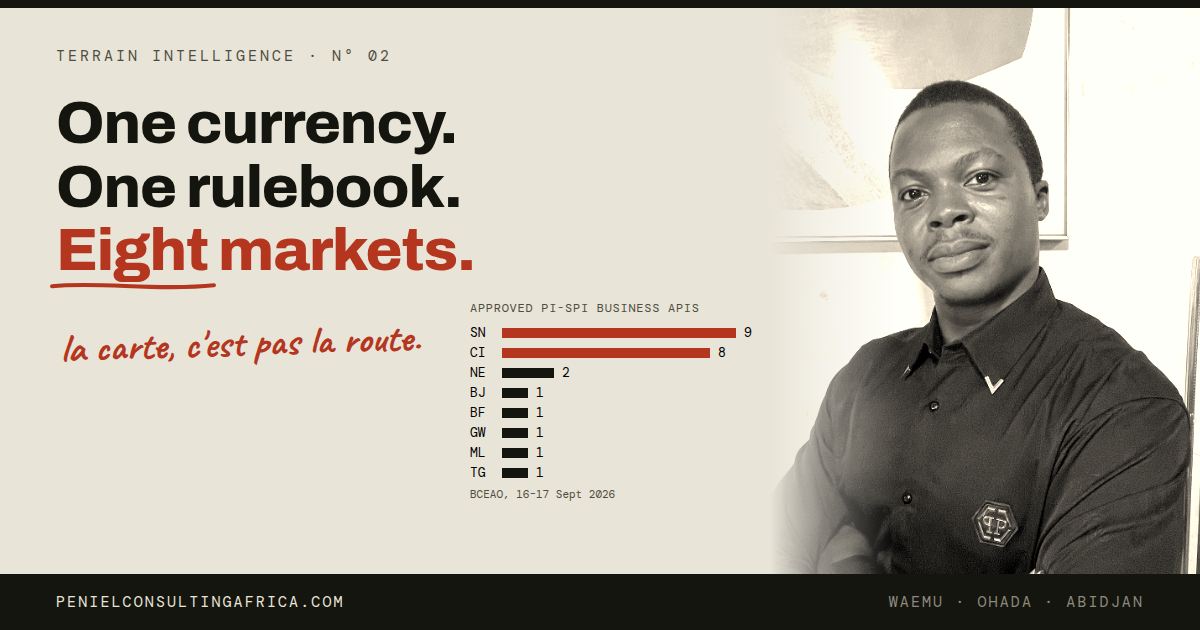
On 16 and 17 September 2026, the BCEAO published the list of Business APIs approved for PI-SPI, its instant payment rail. One text, one central bank, one timetable for everybody.
Here is the count by country. Senegal, 9. Côte d'Ivoire, 8. Niger, 2. Benin, Burkina Faso, Guinea-Bissau, Mali and Togo: one each.
Two countries hold seventeen of the twenty-four lines. In five of the eight, a single approved player.
The rule was identical. The market that received it wasn't.
Same paperwork, three prices
Setting up a limited company (SARL) in Côte d'Ivoire. The public eRegulations portal publishes the schedule line by line: 289,200 FCFA through the CEPICI one-stop shop, in two to four days; 478,900 FCFA going from office to office, in thirteen to twenty-two days. The legal result is the same.
On the ground I've seen three levels. Around 100,000 FCFA, it isn't a firm, it's someone who knows the way: the company exists, and after that, nobody. From 170,000 to 200,000 FCFA it's a firm, and tax follow-up is included: when to pay, how much, how, so the company isn't shut down administratively a year later.
So the price gap doesn't buy the formality. It buys what comes after.
Same regulation, a dead text
Exchange control is common to all eight countries. Yet much of the advisory material in circulation still cites Regulation 09/2010/CM/UEMOA. It was repealed on 20 December 2024 by Regulation 06/2024/CM/UEMOA, signed in Bamako, article 35. Article 36 put it into force the same day.
A common rule protects no one if nobody checks which one is in force.
Same licence, one date for everyone
Since BCEAO instruction 001-01-2024 of 23 January 2024, offering a payment service in the Union requires a licence. The compliance window was pushed twice, first to 31 January 2025, then to 1 May 2025. Since then, avis 004-03-2025 of 19 March 2025 is blunt: from 1 May 2025, any entity not licensed under that instruction must stop offering payment services in the Union.
One date, eight countries, and fintech ecosystems that differ in size and in the number of files a regulator has to process. The rule lands on the same day everywhere. It doesn't land on the same ground.
Same language, not the same text
I review campaigns global brands prepare for French-speaking Africa. The flaw I see most often: the headline is in French, the badges are still in English, and nothing says whether the content is dubbed in French. That's the first thing this audience checks.
Nobody writes in to complain. They just move on.
What it means for your plan
If your entry plan says "WAEMU", it isn't finished. Ask it four questions. Which city? Which bank? Which text is in force? And who picks up the phone the day something jams?
Come with a map of the zone. Leave knowing which street you're walking in on.
The map is not the road.
What I have not verified
The BCEAO list counts approvals, not services open to the public. How many actually work in each country, no public document says.
The eRegulations schedule is calculated for a SARL with one million FCFA in capital; proportional items change with your situation. Its last update date was not recorded.
The street prices (100,000 and 170,000–200,000 FCFA) are direct observations in Abidjan, not a published tariff.
Sources
- BCEAO, Homologation des API Business de la Plateforme Interopérable du Système de Paiement Instantané (PI-SPI), 16 September 2026, updated 17 September 2026. Country count taken directly from the document.
- eRegulations Côte d'Ivoire, company creation through the CEPICI one-stop shop (7 steps, 289,200 FCFA, 2–4 days): cotedivoire.eregulations.org/procedure/96/101
- eRegulations Côte d'Ivoire, company creation directly with each administration (16 steps, 478,900 FCFA, 13–22 days): cotedivoire.eregulations.org/procedure/93/95
- BCEAO, instruction 001-01-2024 of 23 January 2024 on payment services in the Union; avis 004-03-2025 of 19 March 2025 on the end of the transition period (1 May 2025 deadline).
- UNCTAD (UNCTADstat), structure of exports by product group: primary goods accounted for 76.7% of Africa's merchandise exports in 2025.
- Regulation 06/2024/CM/UEMOA of 20 December 2024 on the external financial relations of WAEMU member states, articles 35 and 36.
- Field observations, Abidjan, 2026.
Written from Abidjan. Every one of these documents is public. It only took reading them country by country.
Planning an entry — or bleeding in one?
Book a 20-minute Terrain Briefing. Bring one specific market question; leave knowing what it costs to get it right versus wrong.
Book a Terrain Briefing