PI-SPI, One Year On: 175 Doors, and a Ceiling at 8,000 Francs
On 30 September 2025, in Dakar, the BCEAO launched its instant payment platform and promised people "simple, free and instant" access to their money.
A year later to the day, the connection deadline fell for banks, e-money issuers and payment institutions. Microfinance has until 30 June 2027. Many were waiting for another extension, the way you wait for rain the radio has promised. It did not come.
Instead, the central bank published a list, then a press release. And the press release changed the meaning of one word.
What was published
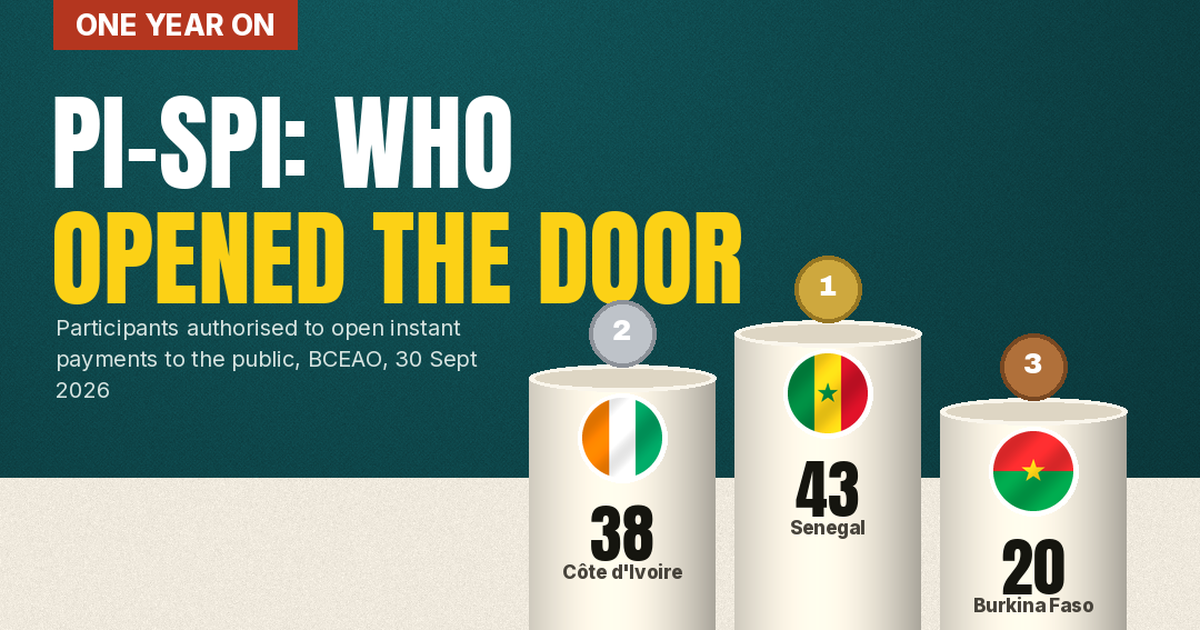
On 30 September 2026, the BCEAO published its List of participants authorised to open PI-SPI services to the public. One hundred and seventy-five names:
| Country | Participants |
|---|---|
| Senegal | 43 |
| Côte d'Ivoire | 38 |
| Burkina Faso | 20 |
| Mali | 19 |
| Benin | 18 |
| Togo | 17 |
| Niger | 13 |
| Guinea-Bissau | 7 |
In Côte d'Ivoire, all four big mobile wallets are on it: Orange Money, MTN Money, Moov Money and Wave Côte d'Ivoire. In Senegal, Wave Digital Finance too.
On 2 October 2026, a press release: "175 participants connected", and "more than 38 million people" able to access instant payments. Then three decisions, effective 2 November 2026:
- interoperable e-money transactions within the Union must go through PI-SPI;
- on sending, domestic transfers are free up to 8,000 FCFA cumulative per day, per user and per participant; above that, fees of 0 to 0.8% are allowed;
- on receiving, it is free, with no limit.
The same terms will apply between Union countries from 1 June 2027.
The word that changed
In 2025, "free" was a promise. In 2026, it is a ceiling: a little over 12 euros a day.
The BCEAO owns the arithmetic. At that threshold, it writes, free covers 75% of e-money transactions in the Union. In other words, three quarters of transfers are small, and those are the ones it protects. The trader sending 50,000 francs to a supplier is already on the other side of the line.
It is a defensible choice. But call it by its name: the universal free of opening day has become targeted free. The release itself speaks of "better targeting of the populations likely to benefit from free transfers". You only target what you have stopped giving to everyone.
Where I was wrong
On 20 September I wrote on this site that the number of institutions open to the public "never appears", that it was "an absent number".
That was wrong.
Since launch, the BCEAO has published lists of institutions authorised to open services to the public: sixty-two names in early October 2025, an update in February 2026, one hundred and four at the end of July according to the business press, and these 175 at 30 September. I was reading the press releases. The answer was sleeping in the lists, on the same website.
I had also counted fifteen companies behind the twenty-four approved API Business lines. Recounted name by name on the BCEAO list, there are sixteen. Ecobank holds eight lines, Touchpoint two, and the other fourteen are distinct.
Both articles are corrected, and they say where. I would rather pick up my arrow in front of you than leave it rotting in the grass.
What is still not published
The list says who is allowed to open. It does not say who actually serves.
No usage figures. No transaction count, no values, no active users. "38 million people" who can access is not 38 million people who use. A tarred road to the village does not tell you how many lorries take it.
No figures per participant. Being on the list does not tell you whether the service works at the counter, at what time of day, or with what failure rate.
Fee-sharing between participants is not publicly settled. The Senegalese press, OSIRIS among others in late September, reports that cost-sharing between institutions is still under discussion, and that smaller players fear it. I have read no BCEAO text that settles it.
The other side of the coin
Money will go and get paid somewhere else. When a road becomes free, the toll moves. The release caps fees on interoperable transfers. It says nothing about transfers inside a single network, or about cash withdrawal. The Senegalese press already cites a Wave-to-Wave transfer being charged where the same amount to another network via PI-SPI would not be. I have not seen Wave's new tariff: I flag it as a warning, not as a fact.
The Sahel is not empty, but it is thin. Mali 19, Burkina 20, Niger 13. In my previous piece I admitted knowing nothing about those three countries. Now I know they are on the list. Wave, however, appears neither in Mali nor in Burkina. Niger lists only two mobile wallets.
The central bank blurs its own counters. In June it wrote "80 participants connected". By the end of July, its list of institutions authorised to open already held one hundred and four, according to Sikafinance. In October it writes "175 participants connected", exactly the number on its opening list. The line between connected and open, which I treated as sacred, is less sacred in its own texts than in mine.
What this changes if you are a company in the zone
Before 2 November, ask your bank and your operator for three things in writing: their PI-SPI tariff above 8,000 francs, their tariff on their own network, and their withdrawal fees. Your real cost will hide in the gap between the three.
If you pay suppliers or agents by mobile money, your average amount almost certainly exceeds 8,000 francs per day per account. Free does not concern you; the 0 to 0.8% does. Negotiate it now, while everyone is hunting for first customers.
If you are entering the market in 2027, watch 1 June. That day, a transfer from Dakar to Abidjan on PI-SPI is meant to cost what a transfer from Plateau to Yopougon costs. It will be the real birthday of the regional rail. Or the next deadline that gets moved.
A payment rail is like a well dug in the middle of the village. On the day it is dug, everyone claps. What counts is how many buckets have gone down it after a year. That number, the BCEAO has not published yet.
Come with the date; leave knowing what it really costs.
What I could not verify
- The fee terms that applied before 2 October 2026. The press reports a number of free receipts per month followed by fees; I have not read the BCEAO text that set them.
- The figure of 45 institutions on launch day, repeated in the press: no BCEAO document found.
- Wave's new tariff: not published, to my knowledge.
- Fraud, outages, user complaints: nothing documented found. That is not proof nothing is happening.
Sources
- BCEAO, List of participants authorised to open PI-SPI services to the public (175), 30 September 2026 — per-country count reread in the document.
- BCEAO, press release of 2 October 2026 — 175 participants, more than 38 million people, mandatory from 2 November 2026, free up to 8,000 FCFA cumulative per day, fees of 0 to 0.8%, free receipt, intra-WAEMU transfers from 1 June 2027.
- BCEAO, official launch of PI-SPI, Dakar, 30 September 2025.
- BCEAO, press releases of 2 April and 25 June 2026 — connection and extension.
- BCEAO, List of approved PI-SPI API Business (24), September 2026 — recounted name by name.
- Wakatsera (October 2025), Financial Afrik (5 March 2026), Abidjan4All citing Sikafinance (July 2026) — earlier lists of 62 and 104 institutions.
- OSIRIS (Senegal), September–October 2026 — Wave and PI-SPI, cost-sharing.
- Financial Afrik, 4 October 2026; Senego, 5 October 2026 — coverage of the 2 October release.
Written from Abidjan. Both BCEAO lists were recounted by hand on 8 October 2026.
Planning an entry — or bleeding in one?
Book a 20-minute Terrain Briefing. Bring one specific market question; leave knowing what it costs to get it right versus wrong.
Book a Terrain Briefing