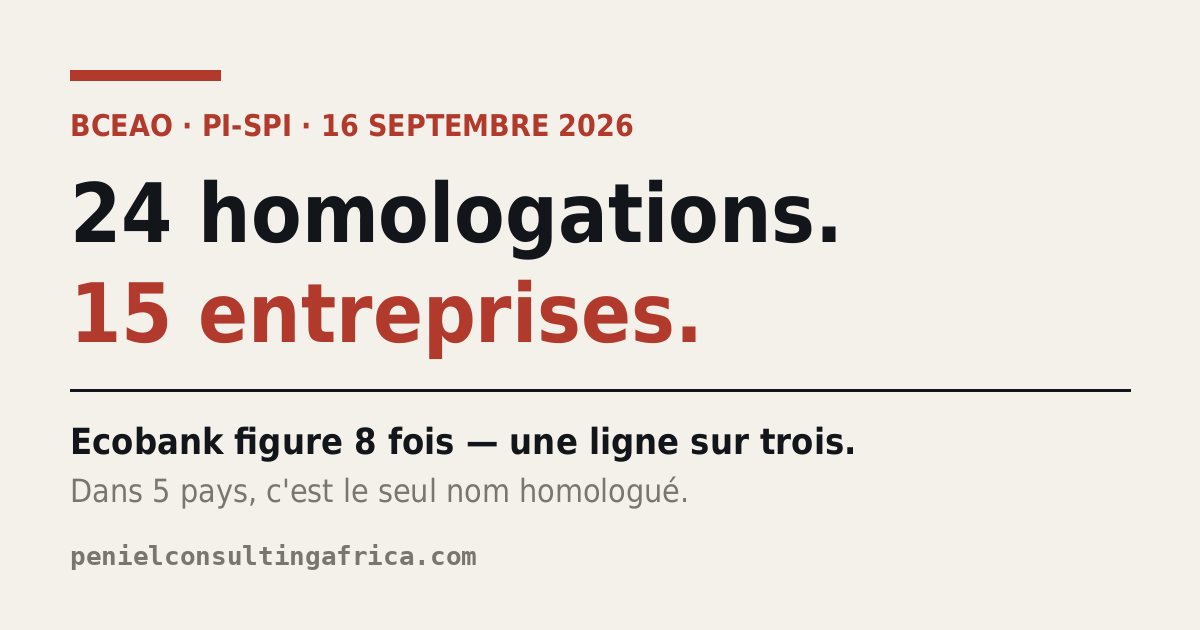
Twenty-Four Names. Fifteen Companies.
On 16 September 2026 the Central Bank of West African States published a list. Two pages, one table, eight country columns. Title: Homologation of PI-SPI Business APIs. Corrected the following day.
Nobody did much with it. It is an administrative document and it looks like one.
Count it.
What the list says when you read it out loud
Twenty-four clearances. Distributed as follows: Benin 1, Burkina Faso 1, Côte d'Ivoire 8, Guinea-Bissau 1, Mali 1, Niger 2, Senegal 9, Togo 1.
First observation, immediate: seventeen of the twenty-four sit in Côte d'Ivoire and Senegal. Seventy-one per cent of a regional list held inside two countries. The other six states share seven lines between them.
Second observation, and this one requires reading the names: Ecobank appears eight times. Once per country. One clearance in three, across the whole Union, carries the same name.
Third observation, and nobody has raised it. Touchpoint Financial Services appears twice — in Côte d'Ivoire and in Senegal. So it is not twenty-four companies that have been cleared.
It is fifteen.
Twenty-four lines. Fifteen companies. For eight countries, one hundred and forty million people, and the layer that decides how businesses pay each other automatically.
What a Business API is, and why it concerns you
The term is technical and it puts people off. It shouldn't.
A Business API is the door through which a company's software talks directly to a bank's. Your supplier payments go out on their own. So does payroll. Your receipts land back in your accounts without a hand retyping them.
Without it, you stay on the manual version: a transfer order, a signature, an employee, a typo one day in ten.
With it, you are plugged into the regional rail.
So look at the list through a finance director's eyes. A company in Lomé, Bamako, Ouagadougou or Bissau that wants to automate its payments on PI-SPI does not have a market in front of it. It has one counter.
One price. One service level. One processing time. And nobody to compare them against.
What the list does not say
The document is short. I looked for other things in it and did not find them.
No tariff schedule. Not a figure, not a ceiling, not a principle. This is not a hole in my research: it is a hole in the document. The PI-SPI launch communiqué, September 2025 in Dakar, promised individuals access that was "simple, free and instant". What a business pays, and to whom, is written nowhere I have been able to open.
Only two mobile operators. MTN MFS in Côte d'Ivoire, Orange Finances Mobiles in Senegal. Two out of twenty-four. Mobile money carries retail payments across this zone — on the business layer, it barely exists.
No queue. How many applications are under review in the five single-supplier countries? For how long? The list does not say, and I found no document that does.
The number nobody has ever published
Go back three months.
Communiqué of 2 April 2026. Eighty participants connected: fifty-nine banks, nine e-money institutions, eleven microfinance institutions, one payment institution. Deadline set at 30 June.
Communiqué of 25 June 2026, five days before that deadline. Eighty participants connected as at 24 June. Seventy-four institutions in live testing. And the deadline pushed back — to 30 September for banks, e-money institutions and payment institutions; to 30 June 2027 for microfinance.
Eighty in April. Eighty in June. Across the entire period when the deadline was running, public and binding, the counter did not move by one.
And the wording of the extension is worth stopping on: the deadline is extended "for the effective opening of services".
Connected, then, is not open. The regulator says so itself, in its own text.
So how many are open?
I reread all three communiqués — the launch, April, June. The number of connected participants is there. The number in testing is there. The number of institutions actually open to the public appears in none of them.
This is not a low figure. It is an absent one.
What it changes if you go in
The deadline falls on 30 September 2026. Ten days away.
Three things to do now, not later.
Ask in writing. Is your bank connected to PI-SPI, or testing? These are not the same thing and nobody will volunteer the distinction. Put the question in a letter and keep the answer.
Do not sign long where there is only one door. A three-year commitment made in a market with a single cleared provider is negotiated at today's price and endured for the following two years. Connect now. Negotiate short. Revisit at every update of the list — it has already been corrected once within twenty-four hours.
And on 30 September, watch what the central bank publishes, not what it announces. If a number of institutions actually open finally comes out, the file is moving. If it does not, you will know what to make of the next deadline.
A date pushed back once is a schedule.
A figure never published is an answer.
What I could not verify
The pispi.bceao.int portal serves an expired certificate and refuses the connection. I worked from the PDF communiqué, directly accessible, and not from the portal.
I found no BCEAO text setting a tariff schedule, a ceiling or a billing principle applicable to institutions and businesses on PI-SPI.
I could not establish the controlling ownership of each of the fifteen cleared companies. For several of them, no public filing is accessible.
I found no document describing what a Business API clearance requires: capital, cost, review period, right of appeal.
Finally, I could not establish the real connection status of institutions in Mali, Burkina Faso and Niger — states that have left ECOWAS but remain members of WAEMU, the CFA franc, the BCEAO and OHADA. It is the most interesting question in the file. It is also the one on which I have nothing.
Sources
- BCEAO, Homologation des API Business de la Plateforme Interopérable du Système de Paiement Instantané (PI-SPI), 16 September 2026, updated 17 September 2026. Twenty-four clearances across eight countries. Count and names taken directly from the document.
- BCEAO, communiqué of 2 April 2026 — PI-SPI connection. Deadline 30 June 2026; eighty participants connected, of which 59 banks, 9 e-money institutions, 11 microfinance institutions and 1 payment institution.
- BCEAO, communiqué of 25 June 2026 — extension of the connection deadline. Eighty participants connected as at 24 June 2026; seventy-four institutions in live testing. New deadlines: 30 September 2026 and 30 June 2027.
- BCEAO — official PI-SPI launch, 30 September 2025, Dakar. "Simple, free and instant access to their funds."
Written from Abidjan. The list has been public since 16 September. It was enough to count the names instead of the lines.
Planning an entry — or bleeding in one?
Book a 20-minute Terrain Briefing. Bring one specific market question; leave knowing what it costs to get it right versus wrong.
Book a Terrain Briefing